English
 Spanish


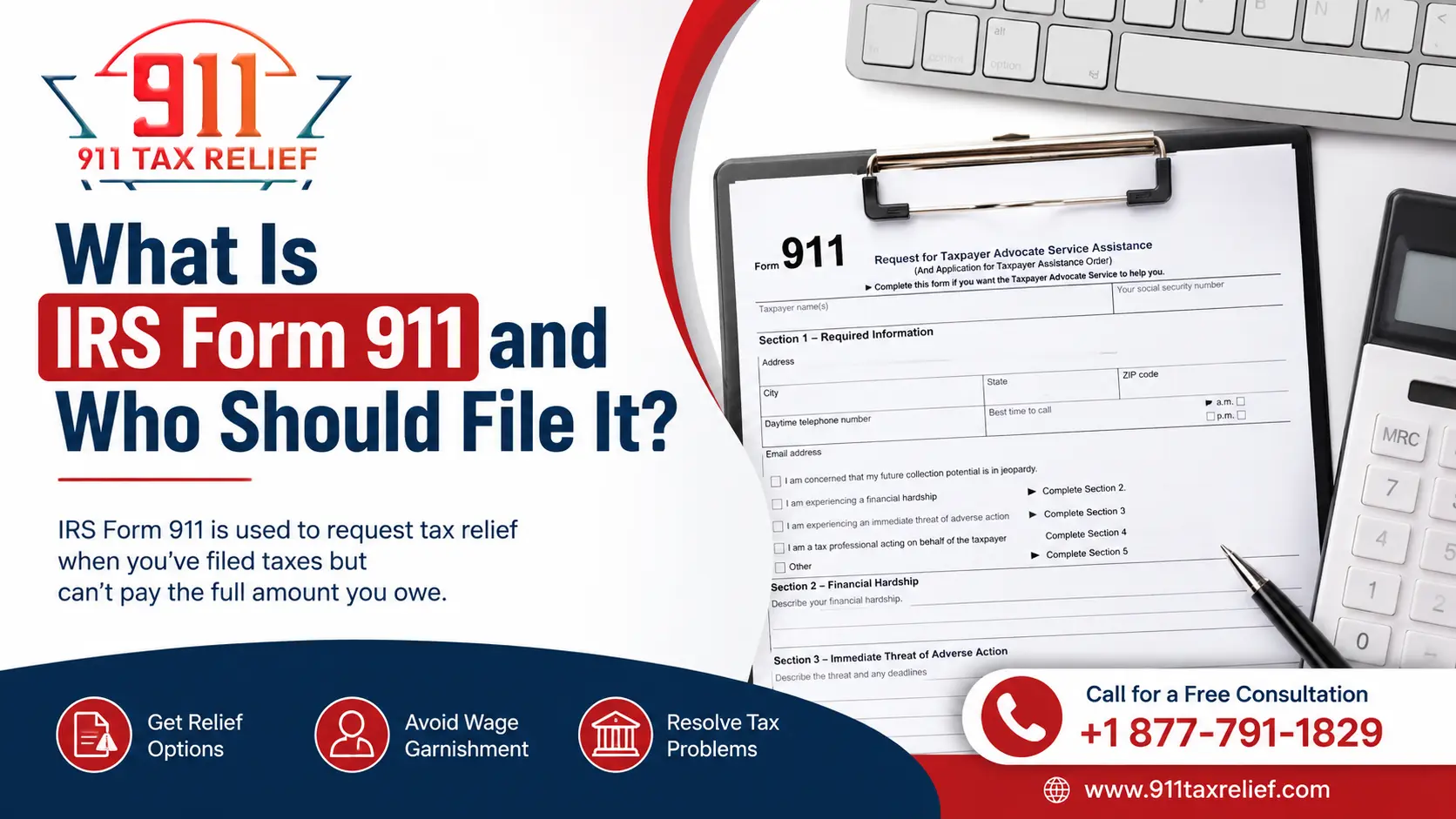
If you have been chasing the IRS for months and getting nowhere, there is a form most taxpayers have never heard of. It is called IRS Form 911, and despite the number, it has nothing to do with emergency services. It is your formal request for help from the Taxpayer Advocate Service.
For a lot of people, this form is the difference between a problem that drags on for another year and a problem that finally moves. This guide explains what IRS tax Form 911 actually does, who qualifies, how to fill it out properly, and where to send it under the latest version of the form.
What Is IRS Form 911?
The full name is Form 911, Request for Taxpayer Advocate Service Assistance (and Application for Taxpayer Assistance Order). The current version is the June 2026 revision, and you can download it free from IRS.gov.
You use this one-page request to tell the Taxpayer Advocate Service three things:
- Who you are and which tax year or form the problem involves
- What the tax issue is and what trouble it is causing you
- What specific relief you want
That is it. There is no filing fee. There is no application process beyond the form itself. The IRS estimates the average person needs about 30 minutes to complete it.
One thing worth clearing up early: filing Form 911 does not guarantee you get help. It opens a request. The Taxpayer Advocate Service reviews it and decides whether your situation meets their case acceptance standards.
Who Is the Taxpayer Advocate Service?
The Taxpayer Advocate Service, usually shortened to TAS, is an independent organization inside the IRS. That sounds like a contradiction, but it is by design. TAS employees sit within the IRS structure yet work on behalf of taxpayers, not on behalf of collections or examination.
Their job is to step in when the normal IRS process has broken down. That could mean an account issue nobody has touched in six months, a levy that is about to hit while your case is still under review, or a refund that vanished into the system with no explanation.
TAS help is always free. They also protect the rights listed in the Taxpayer Bill of Rights, which includes your right to quality service, your right to challenge the IRS position, and your right to a fair and just tax system.
What TAS is not: they are not your representative. They will not argue your legal position the way an enrolled agent or tax attorney would, and they will not negotiate a settlement for you. If you need someone on your side of the table, that is a different job. Our tax resolution services page explains where professional representation fits alongside a TAS request.
Who Should File IRS Form 911?
TAS groups qualifying situations into three broad buckets. If your problem fits any of them, you have a reasonable case for filing.
1. Financial hardship, also called economic burden
This is the most common reason people file. The IRS calls it economic harm, and it covers situations where a tax problem or an IRS action is causing real financial damage. Ask yourself:
- Are you at risk of losing your home or your vehicle?
- Are you struggling to pay for food, utilities, or medical care?
- Will you be unable to get to work if the IRS takes your car or your bank balance?
- Are you facing costs you cannot afford, including professional fees, if the issue is not fixed?
- Will you suffer damage that cannot be undone, such as long-term credit harm or lost income?
The law behind this is Internal Revenue Code section 7811, which defines significant hardship to include an immediate threat of adverse action, a delay of more than 30 days in resolving an account problem, significant costs the taxpayer will incur if relief is not granted, and irreparable injury or long-term adverse impact.
If the IRS has already started or threatened enforcement, act quickly. A pending wage garnishment release or IRS tax levy release is often time-sensitive, and bank levies in particular run on a short hold period.
2. IRS system or process failure
This category covers the cases where nothing is technically being done wrong to you, but the machinery has simply stopped working. Common examples:
- More than 30 days have passed and your account problem is still unresolved
- The IRS promised a response by a certain date and that date came and went
- Your amended return or correspondence appears to have disappeared
- An automated notice keeps generating even though the underlying issue was fixed
The 30-day marker matters. Once you cross it, you have a clear, documented reason to ask TAS to step in.
3. Fair and equitable treatment concerns
The third category is for situations where you believe the IRS has not applied the law or its own procedures correctly, or has not treated you fairly. This includes cases where an IRS office denied the relief you asked for, or granted it too late to do you any good.
Businesses can file too
Form 911 is not just for individuals. Partnerships, corporations, trusts, estates, and tax-exempt organizations can all file. If your business is dealing with a payroll tax problem that has stalled inside the IRS, the same rules apply. A properly authorized officer signs the request and includes their title.
Who Should Not File Form 911?
Being honest about this saves you weeks.
You have not tried the normal route yet. TAS generally expects you to have contacted the IRS first. If your notice is three weeks old and you have not called the number on it, start there.
Your problem is a routine question. Filing status questions, how to read a notice, basic filing help. TAS is not a general help desk, and their resources are limited.
You want to argue that the income tax is not legal. The Form 911 instructions are direct about this. TAS will not consider frivolous arguments, and using the form to raise them can trigger a penalty of $5,000 on top of any other penalty that applies. Publication 2105 lists what the IRS treats as frivolous.
You actually need a resolution program, not an advocate. If your real problem is that you owe more than you can pay, TAS cannot settle the debt for you. What you need is the right program. That might be an installment agreement, an Offer in Compromise, penalty abatement, or Currently Not Collectible status. TAS may help push a stalled application forward, but they do not replace the application itself.
How to Fill Out IRS Form 911, Section by Section
The form has two sections. Most people only need the first.
Section I: Taxpayer information
Lines 1a to 2b. Your name exactly as it appears on the return, plus your Social Security Number or ITIN. Businesses use their EIN. If the issue involves a joint return, add your spouse's name and number.
Lines 3a to 3d. Your current mailing address. If you have moved since filing, use where you live now.
Line 4. A daytime phone number where someone can actually reach you.
Line 5. Your email address. Leaving this blank is fine. Providing it means you consent to encrypted email contact from TAS about your case.
Line 6. Fax number, if you have one.
Line 7a. Pick how you want TAS to update you: email, letter, or phone call. Choose the one you check most often.
Line 7b. Tick this box only if you are comfortable with confidential tax details being left on your voicemail. If other people can hear your messages, leave it alone.
Line 8. A point of contact, used mainly by businesses and entities when no third party is listed in Section II.
Line 9. Note any special communication needs here, including a language other than English or sign language interpretation.
Line 10. The tax form the problem relates to. Most individuals write 1040. Employment tax issues use 941.
Line 11. The tax year or period. Income tax uses the year. Employment tax uses the quarter.
Lines 12a and 12b: the part that decides your case
Everything above is data entry. These two boxes are where your request is won or lost.
Line 12a asks you to describe the tax issue and the difficulty it is creating. Be specific and be factual. Include:
- What the IRS did or failed to do
- The dates you contacted the IRS and what you were told each time
- Notice numbers and letter dates
- If the delay is over 30 days, the date you first asked the IRS for help
- The real world consequence, in plain terms
Weak version: "The IRS is taking too long and it is causing me problems."
Strong version: "I filed an amended 2024 return on March 3, 2026. I called on May 12 and July 8 and was told each time it was still in process. My employer began withholding $840 per pay period on July 22 under a wage levy. My monthly rent is $1,450 and I cannot cover it at my reduced take-home pay."
Line 12b asks what relief you want. Say exactly what action you need. "Release the wage levy and process the 2024 amended return" is useful. "Please help me" is not.
Attach supporting documents. Notices, bank statements, eviction or shut-off warnings, medical bills, pay stubs showing the garnishment. Documentation is what turns a claim of hardship into a demonstrated hardship, and it usually speeds things up.
Lines 13 and 14: signature. Both spouses sign for a joint request. Only the spouse requesting help signs if the request is individual. Business requests need a signature from an authorized officer with their title.
Section II: third party information
Fill this in only if someone is acting for you.
- Form 2848, Power of Attorney authorizes a representative to speak and act on your behalf with the IRS.
- Form 8821, Tax Information Authorization only lets your appointee receive and inspect your tax information. It does not let them advocate your position, sign agreements, or represent you.
That difference matters. If you want someone actually fighting your corner, you need Form 2848, not Form 8821.
A representative filling in Section II completes blocks 1 through 7, enters their Centralized Authorization File number, attaches a copy of the authorization, and signs. When an authorized representative submits the request, the taxpayer does not need to sign the form as well.
If you are considering having a professional handle this, our IRS debt help team files these requests routinely and knows how to frame lines 12a and 12b.
Where to Send Form 911
This is the part where older articles will lead you wrong. Guidance used to send you to a local TAS office fax number based on your state. The current revision of the form lists central submission channels instead:
- Email: tas.form.911.request.for.assistance@irs.gov
- Fax: (855) 828-2723
- Mail: Taxpayer Advocate Service, Kentucky Drive, MS 11 G, Florence, KY 41042
- From overseas: fax 1 (304) 707-9793, which is not toll free for US callers, or use the same email address
Two cautions. First, email submissions to TAS are not encrypted. Sending the form by email means you accept that. If your comfort level is low, fax or mail it. Second, always check page 3 of the copy you download from IRS.gov, because the address and contact details are printed right on the form and are the most reliable source at the moment you file.
You can also call TAS at 877-777-4778, and an IRS employee can complete the form on your behalf if you ask.
What Happens After You File
TAS will tell you whether your request has been accepted, and they may call to talk through the issue. They try the contact method you picked on line 7a, but they can use the others if needed.
If 30 days pass with no response, email tas.form.911.request.for.assistance@irs.gov and write "No Response" in the subject line.
Do not file a second Form 911 for the same issue. Duplicate submissions slow your own case down.
If your request is accepted, you get assigned a case advocate who becomes your single point of contact inside the IRS. That alone solves one of the biggest frustrations taxpayers have, which is explaining the same story to a different person every call.
Three Limits You Need to Understand
Form 911 does not pause any deadline. This is the one that catches people out. Signing and sending this request does not suspend the clock on petitioning the Tax Court over a deficiency, or on requesting a Collection Due Process hearing. Those deadlines keep running. If you have a notice with a response deadline on it, protect that deadline separately.
TAS does not represent you. They advocate for correct treatment. They do not build your case, negotiate your settlement, or argue tax law on your behalf.
Acceptance is not automatic. TAS has limited resources and high demand. A well-documented, specific request has a far better chance than a vague one.
Common Mistakes That Get Requests Rejected
- Writing two vague sentences in box 12a and skipping the consequences entirely
- Not naming the relief you want in box 12b
- Filing before contacting the IRS through normal channels
- Attaching nothing, so TAS has to take your hardship claim on trust
- Using an address the IRS cannot match to your account
- Forgetting the spouse signature on a joint request
- Sending it to a local IRS office instead of a TAS channel
- Filing a duplicate two weeks later because nobody replied yet
Frequently Asked Questions
Is IRS Form 911 the same as an emergency call? No. The number is a coincidence. Form 911 is a written request for Taxpayer Advocate Service assistance and it is handled on a normal processing timeline, not instantly.
Does Form 911 cost anything? No. The form is free to download and Taxpayer Advocate Service help is free for taxpayers who qualify.
How long does the Taxpayer Advocate Service take to respond? There is no guaranteed turnaround. The form instructions tell you to follow up by email with "No Response" in the subject line if you have heard nothing after 30 days.
Can Form 911 stop a wage garnishment or bank levy? It can help, but it is not an automatic stop. TAS can push for a release when enforcement is causing genuine hardship. If enforcement has already started, do not rely on Form 911 alone. Get a resolution path moving at the same time through tax levy help.
Can my accountant or attorney file Form 911 for me? Yes. They complete Section II and attach Form 2848 or Form 8821. If an authorized representative submits it, you do not need to sign the form yourself.
Can I file Form 911 for a business? Yes. Businesses and other entities can file. A properly authorized officer signs and includes their title.
Will TAS reduce what I owe? No. TAS makes sure the IRS handles your account correctly and fairly. Reducing a balance is a separate process through programs like an Offer in Compromise or penalty abatement.
What if I have several unfiled returns? That usually needs fixing first. The IRS generally expects filing compliance before it will approve most resolution options. Our back tax help page covers how unfiled years are handled, including cases where the IRS filed a Substitute for Return on your behalf.
The Bottom Line
IRS tax Form 911 is a genuinely useful tool that is badly underused. If an IRS delay or an IRS action is doing real damage to your finances, and normal channels have failed you, this form gets your file in front of someone whose job is to fix it.
Just be realistic about what it does. It is a request for internal advocacy. It is not representation, it does not settle debt, and it does not buy you extra time on a legal deadline.
If you are dealing with a levy, a garnishment, years of unfiled returns, or an audit that has gone sideways, you are likely dealing with two problems at once: a stalled process and an underlying balance. Form 911 addresses the first one. The second needs a resolution strategy.
911 Tax Relief works with individuals and businesses across the United States on exactly these situations, from IRS audit help to full tax debt relief. If you are not sure which problem you are actually facing, contact our team for a free case review and we will tell you straight.
This article is general information about IRS Form 911 and the Taxpayer Advocate Service. It is not legal or tax advice, and it does not create a client relationship. Tax rules and IRS procedures change. Always check the current version of Form 911 and its instructions on IRS.gov, or speak with a licensed tax professional about your own situation.
Sources: IRS Form 911 (Rev. 6-2026) and its instructions; Taxpayer Advocate Service, taxpayeradvocate.irs.gov; Internal Revenue Code section 7811.