English
 Spanish


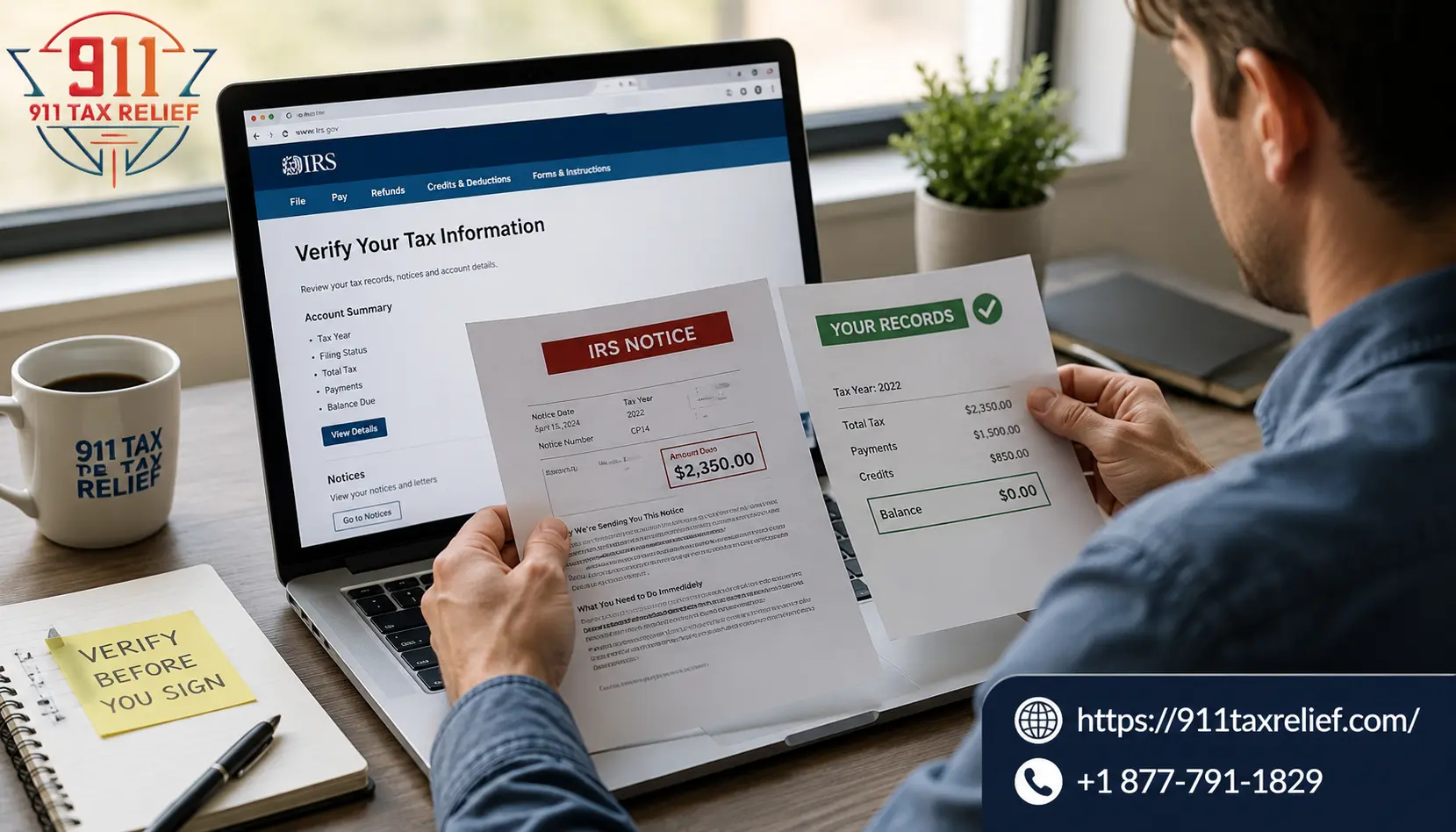
Quick Answer
To check if a tax relief company is legitimate, verify its legal business identity, confirm the credential of the licensed person who will represent you before the IRS, review its complaint history, get the full fee structure in writing, and ask which specific IRS program it plans to pursue. Then compare that plan with the options the IRS already offers you directly.
Why You Should Check a Tax Relief Company Before Hiring It
When you owe back taxes, the pressure is real. A levy notice or a garnished paycheck makes you want the problem solved today. That urgency is exactly what bad operators sell against.
The Federal Trade Commission warns that some tax relief companies collect large upfront fees, promise to apply for IRS hardship programs, and leave people deeper in debt than before. The FTC notes that most taxpayers do not qualify for the programs these operators advertise, and that in many cases the companies never settle the debt at all.
The IRS raises the same concern from its side. Its 2026 Dirty Dozen list of tax scams includes "OIC mills," which the agency describes as operations that overpromise results and charge high fees to taxpayers who do not qualify for an Offer in Compromise.
None of that means the industry is a fraud. Plenty of enrolled agents, CPAs and tax attorneys resolve serious IRS problems every day, and hiring one is often the right call when your case involves audits, payroll tax liability, unfiled returns or an active levy. The point is simpler. You are about to hand a stranger your Social Security number, your bank statements and possibly several thousand dollars. An hour of checking first is cheap.
Here is one line worth remembering before you read anything else. Only the IRS or your state tax agency can decide what you actually qualify for. Any company that tells you that you "qualify" before it has looked at your account transcripts is guessing, or selling.
9 Things to Verify Before Hiring a Tax Relief Company
1. Verify the legal business behind the brand name
What to verify: The registered legal entity, how long it has operated, and its physical address.
Marketing names and legal names are often different. A television ad, a mailer and a call center can all belong to separate companies.
How to check it: Search the business name in your state's Secretary of State business registry, or the registry of the state listed on the company's contact page. Look for the entity name, registration date and status. Then put the street address into a map search. A registered office in a commercial building is normal. A mailbox store address for a company claiming a nationwide staff of professionals deserves a follow-up question.
What should raise concern: No registered entity anywhere, a company formed a few months ago that advertises decades of experience, or a refusal to give you a legal entity name in writing.
Your action: Ask directly, "What is the full legal name of the company I would be contracting with?" Save the answer.
2. Find out who will actually handle your case
What to verify: Whether the person selling you the service is the person who will represent you.
This is the single most misunderstood part of the industry. Many tax relief operations run a sales floor. The person on the phone during your free consultation may be a commissioned salesperson with no tax credential at all. Your case is then passed to a case manager, and only later to a licensed representative who deals with the IRS.
That structure is not automatically wrong. A firm can have intake staff and licensed practitioners, just like a medical practice has a front desk. It becomes a problem when the salesperson makes technical promises that the licensed professional never agreed to.
How to check it: Ask three questions. Who is the licensed person who will sign my IRS power of attorney? What is their credential and license number? Will I be able to speak with them directly before I pay?
What should raise concern: "Our team handles that," with no name attached. Or a representative who cannot tell you their own credential.
Your action: Write down the name and credential of the assigned representative before you pay anything.
3. Confirm the credential and the right to represent you
What to verify: That a real, currently licensed professional will appear on your IRS Form 2848.
Form 2848, Power of Attorney and Declaration of Representative, is the form that gives someone authority to speak to the IRS for you. The IRS requires your representative to be an individual eligible to practice before the agency, which includes attorneys, certified public accountants and enrolled agents, along with a few limited categories such as enrolled actuaries and, in narrow circumstances, unenrolled preparers and family members. A sales agent cannot sign it. A "tax consultant" with no credential cannot sign it.
How to check it:
- Enrolled agents and credentialed preparers: search the IRS Directory of Federal Tax Return Preparers with Credentials and Select Qualifications. It lists preparers with an active PTIN who are enrolled agents, CPAs, attorneys, enrolled retirement plan agents, enrolled actuaries or Annual Filing Season Program participants. Note that the directory is updated weekly and that some eligible preparers opt out, so an absent name is a question to ask rather than proof of a problem.
- CPAs: search your state Board of Accountancy license lookup.
- Attorneys: search the state bar directory for the state where they are admitted.
- Discipline: the IRS Office of Professional Responsibility publishes disciplinary actions taken against practitioners under Circular 230, and state boards and bars publish their own.
What should raise concern: A credential that cannot be found anywhere, a license in a state that has nothing to do with the firm's stated offices, or vague titles like "senior tax specialist" offered in place of a real credential.
Your action: Look up the name yourself while you are still on the call.
4. Investigate complaints and regulatory history
What to verify: What people who already paid this company have said, and whether any regulator has acted.
How to check it:
- Better Business Bureau profile, reading the complaint text rather than only the letter grade
- Your state attorney general's consumer complaint page, and the attorney general of the state where the company is based
- A plain web search for the company name plus words like "lawsuit," "complaint," "attorney general" or "refund"
- Court record searches if the company is large
Read reviews for pattern, not for score. Twenty five-star reviews posted in the same week say less than one detailed review describing what the firm actually did over eight months. Look for reviews that mention outcomes, communication and refunds, because those are the three things that go wrong most often.
What should raise concern: Repeat complaints about the same issue, especially unreturned calls, work never filed with the IRS, or refunds promised and not paid.
Your action: Read at least five negative reviews before you read any positive ones.
5. Get the complete fee structure in writing
What to verify: Total cost, payment timing, what is included, what is not, and the refund policy.
Most reputable firms work in phases. Phase one is an investigation, where the practitioner files the power of attorney, pulls your IRS account transcripts and reviews compliance. Phase two is the resolution work. That model is legitimate, and the investigation is real work. The danger is when the phase one price is quoted, the phase two price is not, and you find out the real number only after you have paid and shared everything.
The FTC's guidance is blunt on this point. It advises against doing business with a company that tells you to pay its whole fee upfront, and warns about companies charging expensive monthly maintenance fees.
Also remember that the company's fee is not the only cost. The IRS charges its own application fee of $205 for an Offer in Compromise, waived for taxpayers who meet the low-income definition in the Form 656 instructions. Unfiled returns usually mean separate tax preparation charges. Ask whether those are included.
Questions that get you a real number:
- What is the total cost if my case goes all the way to resolution?
- Is the second phase priced now, or quoted later?
- What happens to my money if you determine I do not qualify for the program you suggested?
- Are there monthly fees, and when do they stop?
- Is tax return preparation for my unfiled years included?
What should raise concern: A price that drops sharply when you hesitate. A refusal to put the refund policy in writing. Pressure to pay the entire fee today.
Your action: Ask for the fee schedule and refund policy as a document you can read before signing.
6. Test whether the promises are realistic
What to verify: Whether the company is describing outcomes or guaranteeing them.
No private company controls IRS decisions. An Offer in Compromise is accepted based on your reasonable collection potential, which the IRS calculates from your income, allowable expenses and asset equity. Two people with the same balance can get opposite answers because their finances differ.
So an honest professional will speak in conditional terms. "Based on the numbers you gave me, an offer may be worth exploring once I see your transcripts." A sales pitch speaks in certainties. "You qualify. We can settle this for pennies on the dollar."
The IRS has warned specifically about heavy advertising that promises dramatic reductions and suggests anyone can settle tax bills for pennies on the dollar, and it encourages taxpayers to check eligibility using free tools on IRS.gov before paying a third party.
A useful test: ask, "What would make me not qualify?" Anyone who understands the program can answer that in thirty seconds. Anyone who cannot answer it is not doing tax work.
Your action: Treat any guarantee of a specific IRS result as a reason to slow down, not speed up.
7. Ask exactly which strategy they plan to pursue and why
What to verify: That the plan is tied to your actual account, not to a script.
IRS resolution is not one product. The realistic paths include a short-term payment plan, a long-term installment agreement, penalty abatement, Currently Not Collectible status, innocent spouse relief, audit representation, and, for a minority of taxpayers, an Offer in Compromise. Filing missing returns usually comes first, because the IRS expects filing compliance before it approves a settlement.
What a good answer sounds like: "I cannot commit to a path until I pull your transcripts. Based on what you have described, the likely order is filing your 2022 and 2023 returns, then requesting first-time penalty abatement on the 2021 balance, then deciding between an installment agreement and an offer once I see your collection statute dates."
What a weak answer sounds like: "We will file an offer in compromise for you," said before anyone has looked at your account.
What should raise concern: A strategy chosen before your financial review, or a company that only ever recommends one program regardless of the caller.
Your action: Ask them to explain in plain language why the recommended program fits your numbers.
8. Compare the proposal against what the IRS offers you directly
What to verify: Whether you are paying for something you could arrange yourself in twenty minutes.
This is the check almost nobody performs, and it is the one that saves the most money. Some cases genuinely need professional representation. Others do not.
Free tools you can use before you hire anyone:
- IRS Online Account at IRS.gov, to see your balance, notices and payment history
- Online Payment Agreement application. The IRS allows a long-term payment plan when you owe $50,000 or less in combined tax, penalties and interest and have filed all required returns, and a short-term plan when you owe less than $100,000.
- Offer in Compromise Pre-Qualifier tool at IRS.gov/OICtool. The Form 656 booklet points taxpayers to this tool and to the Individual Online Account eligibility check, and notes that using them is recommended though not required before submitting an offer.
- Low Income Taxpayer Clinics. The FTC notes that an LITC may be able to help people of modest means who have a dispute with the IRS.
If your situation is a single year, a moderate balance, all returns filed and no enforcement action, an online payment plan may cover it. If you have payroll tax exposure, several unfiled years, an active levy, a business, or an audit, representation is usually worth paying for.
Your action: Run the pre-qualifier tool yourself, then see whether the company's pitch matches what the tool suggested.
9. Read the contract before you sign it
What to verify: Scope, cancellation, refunds, communication and document handling.
Read for these specific items:
- Scope of work. Does it name the tax years and the services, or is it generic?
- What is excluded. Return preparation, state tax matters, appeals and audit defense are commonly separate.
- Cancellation. Can you cancel, and what do you owe if you do?
- Refunds. Are they prorated by work performed, and who decides?
- Communication. Who is your point of contact, and what is the promised response time?
- Automatic charges. Any recurring billing, and how to stop it.
- Dispute terms. Arbitration clauses and venue provisions affect what you can do later.
A practical note on documents. A legitimate professional will need real financial information: prior returns, income records, bank statements, expense records and identification to complete Form 433-A or 433-B. That is normal. What is not normal is anyone asking for your IRS Online Account login, your ID.me credentials, your online banking password or an EFTPS PIN. No representative needs those. Form 2848 gives them the access they need through official channels.
Your action: Ask for the contract by email, read it away from the phone call, and sign it the next day rather than the same hour.
Red Flags That Deserve Extra Attention
- You are told you qualify for a settlement before anyone reviewed your transcripts
- A guarantee of a specific IRS outcome or a specific settlement amount
- Pressure to decide today, or a discount that expires during the call
- The full fee is demanded upfront
- Recurring monthly fees with no defined end
- No named, verifiable licensed representative
- The company found you first, by cold call, text or letter, right after a lien was filed
- Requests for account passwords, ID.me credentials or banking logins
- Refusal to send the contract before payment
- Refund policy given verbally only
- An address that turns out to be a mailbox service
- Reviews that all appeared in the same short window
One more that gets missed. If a caller claims to be from the IRS and demands immediate payment, that is a different scam entirely. The IRS does not initiate contact with taxpayers by email, text message or social media to request personal or financial information.
Questions to Ask a Tax Relief Company Before Paying
Copy these into your notes and use them on the call.
- What is the full legal name of the company?
- Who will be assigned to my case, and what is their credential and license number?
- Will that person sign my Form 2848?
- Have you reviewed my IRS transcripts yet?
- Which resolution program do you expect to pursue, and why that one?
- What would disqualify me from that program?
- What is the total cost through resolution, not just the first phase?
- What is included, and what will I be billed for separately?
- What is your refund policy if the outcome is not achieved?
- How often will I get case updates, and from whom?
- How long do cases like mine usually take?
- Can you send me the contract and fee schedule to review before I pay?
If a company answers all twelve without hesitation, that tells you something. If it dodges three of them, that tells you something too.
What Information Should You Verify Directly With the IRS?
You do not have to take a company's word about your own tax situation. You can confirm the underlying facts yourself.
Through your IRS Online Account you can check:
- Your actual balance by tax year
- Which returns the IRS shows as filed or missing
- Notices issued to you
- Payment history and any existing payment plan
Through IRS.gov you can also confirm eligibility rules for payment plans, review the Offer in Compromise requirements, and run the Pre-Qualifier tool anonymously. The IRS states that you are eligible to apply for an Offer in Compromise if you have filed all required returns and made required estimated payments, are not in an open bankruptcy proceeding, have a valid extension for a current year return if applying for the current year, and, if you are an employer, have made tax deposits for the current and past two quarters.
If a company's description of your balance, your filing status or your eligibility does not match what the IRS shows, ask why before you pay.
How to Compare Two Tax Relief Companies
Do not compare on price alone. Score both on the same eight lines.
| Factor | What to record for each company |
|---|---|
| Credentials | Name and credential of the licensed representative, verified in an official directory |
| Experience | Cases like yours specifically, such as payroll tax, audits or multi-year unfiled returns |
| Fees | Total through resolution, phase breakdown, monthly charges, exclusions |
| Communication | Named contact, stated response time, how updates are delivered |
| Proposed strategy | The program suggested and the reason it fits your numbers |
| Contract terms | Scope, cancellation, refunds, automatic billing, dispute clauses |
| Complaints | Regulator complaints, BBB complaint text, review patterns |
| Transparency | Willingness to answer the twelve questions and to send documents first |
Fill this in for both. The stronger choice usually becomes obvious, and it is not always the cheaper one.
How to Tell a Real Firm From a Lead Generator
Some websites and phone numbers that look like tax relief firms are actually advertising operations. They collect your details and sell them to whichever company pays for the lead. That is why one form submission can produce calls from four different companies in a day.
Signals that you may be dealing with a lead generator:
- The site has no named professionals, no license numbers and no verifiable office
- The company name on the caller ID does not match the site you filled out
- You get calls from multiple companies after contacting one
- The site is heavy on qualification quizzes and light on service detail
- Nobody can tell you who would sign your Form 2848
There is nothing illegal about advertising networks. The problem is that a lead generator has no responsibility for the outcome of your case. The company that eventually calls you may be fine, or may not be, and you did not choose it.
Is 911 Tax Relief Legitimate? What Should You Verify?
People searching for a 911 Tax Relief scam check are usually asking a fair question, and the honest answer is that you should apply the same nine checks to this firm that you would apply to any other.
Here is what you can verify independently:
- Business identity. 911 Tax Relief lists an Omaha, Nebraska headquarters and an office in Sherman Oaks, California, along with a published phone number. Confirm the entity in the Nebraska business registry and look up the addresses yourself.
- Third-party profiles. The company links from its own website to a Better Business Bureau profile and a Google review profile. Open both and read the content, including anything critical.
- Credentials. The site states that it works with enrolled agents, tax attorneys and licensed tax professionals. Ask for the name and credential number of the specific person who will sign your Form 2848, then verify it in the IRS preparer directory, your state bar or your state accountancy board.
- Fees and contract. Ask for the phase structure, the total expected cost and the refund policy in writing before you pay.
- Strategy. Ask which program is being recommended and why, and expect the answer to reference your transcripts.
We are not going to tell you that this firm is the right choice, because that depends on your case, and no company can promise the IRS will accept any particular resolution. If you want to see the range of matters handled here first, the tax debt relief and tax resolution services pages describe the work in detail, and the about page covers the firm's background. Verify what you read. That is the whole point of this article.
Frequently Asked Questions
How can I tell if a tax relief company is legitimate? Verify the legal entity, confirm the credential of the licensed person who will sign your IRS Form 2848, review complaints with the BBB and your state attorney general, get the full fee structure and refund policy in writing, and ask which IRS program they plan to pursue and why. Then compare that plan with what the IRS offers directly.
Can a tax relief company guarantee that my IRS debt will disappear? No. Only the IRS can decide what you qualify for. An Offer in Compromise is evaluated on your income, allowable expenses and asset equity, so results differ from person to person. Treat any guarantee of a specific settlement as a warning sign.
What should I do if a company asks for a large upfront fee? Slow down. The FTC advises against paying a company's entire fee before any work is done. Ask for a phase breakdown, a written refund policy, and a quote for the second phase before you pay for the first.
How do I check a tax relief company's credentials? Search the IRS Directory of Federal Tax Return Preparers with Credentials and Select Qualifications for enrolled agents and credentialed preparers, your state Board of Accountancy for CPAs, and the state bar for attorneys. The directory includes only credentialed preparers and Annual Filing Season Program participants, and some professionals opt out, so ask about anyone you cannot find.
Who can legally represent me before the IRS? Attorneys, CPAs and enrolled agents can represent taxpayers before the IRS, along with enrolled actuaries and enrolled retirement plan agents within their areas, and a few limited categories such as certain unenrolled preparers, family members and employees. Your representative is named on Form 2848.
How can I verify tax relief company reviews? Read the text, not the star rating. Look for reviews that describe the actual work, the timeline and the fee. Check whether many reviews appeared in the same week. Read the negative reviews and the company's replies to them, and cross-check with BBB complaints and state attorney general records.
What is an OIC mill? It is a term the IRS uses for operations that aggressively market Offer in Compromise services, charge high fees and overpromise results to taxpayers who often do not qualify. The IRS included OIC mills in its 2026 Dirty Dozen list of tax scams.
Can I settle my tax debt without hiring anyone? Sometimes. If you owe $50,000 or less in combined tax, penalties and interest and have filed all required returns, you can apply for a long-term payment plan online, and a short-term plan is available for balances under $100,000. You can also run the Offer in Compromise Pre-Qualifier tool for free. Complex cases involving audits, payroll taxes, business liabilities or active enforcement usually benefit from representation.
What does an Offer in Compromise cost to apply for? The IRS application fee is $205 per offer, and it is waived for taxpayers who meet the low-income certification described in the Form 656 instructions. That fee is separate from anything a company charges you for its services.
What information should I never give an unknown tax relief company? Never share your IRS Online Account or ID.me login, your online banking password, or an EFTPS PIN. A legitimate representative gets IRS access through Form 2848 and gets your financial details through documents you provide, not through your credentials.
Where do I report a problem with a tax relief company? Report it to the FTC at ReportFraud.ftc.gov. You can also file a complaint with your state attorney general, and report a paid preparer's misconduct to the IRS.
Should I be worried if a company contacted me first? Be careful. Federal tax liens are public records, and marketers use them. An unsolicited letter or call that mentions your balance does not mean the sender has any relationship with the IRS. Verify the company before responding, and remember that the IRS does not initiate contact by email, text or social media to request personal or financial information.
Before you pay anyone, confirm five things: the legal company, the licensed person who will represent you, the complaint history, the total fee and refund terms, and the specific IRS program being proposed. Then check that plan against your own IRS Online Account and the free tools on IRS.gov.
A good tax professional will welcome those questions. The answers cost you nothing, and they are the difference between hiring help and buying a promise. If your situation involves an active levy, a garnishment, unfiled years or a business tax balance, get IRS tax problem help from a credentialed professional you have verified, and start with the transcripts rather than the sales pitch.